


Douglas Gordon
Douglas Gordon: A Bridge between Memory, Time and Cinema
Douglas Gordon is undisputedly one of the most prominent and internationally influential artists of his generation. As early as 1996, the Scottish star artist was awarded the prestigious British Turner Prize – an honour that cemented his status as a pioneer of contemporary video and conceptual art. His works radically challenge the audience’s viewing habits and analyse the mechanisms of human perception.
A milestone in his exhibition history in the German-speaking world was the comprehensive retrospective held in 2007 at the Kunstmuseum Wolfsburg. This retrospective was developed in close and intensive collaboration with Gordon himself. The aim of the curators and the artist was to create a setting that would do full justice to the complex nature of his multifaceted body of work and honour his multimedia, often spatially expansive approach.
To this end, the museum’s monumental, large exhibition hall was transformed into a gigantic, immersive ‘black box’. In this artificial darkness, the boundaries between the individual works blurred: large-scale video installations, precisely positioned photographs, conceptual text-based works and floor-to-ceiling monitor walls entered into a direct, almost hypnotic dialogue with one another. The audience did not move through a traditional exhibition of artworks, but through a dynamic Gesamtkunstwerk, acoustically and visually interconnected.
Thematic Focuses and the Magic of ‘Found Footage’
Existential, psychological and philosophical questions lie at the heart of Douglas Gordon’s work. Memory, loss, guilt, duality and rediscovery form the thematic focuses around which his works constantly revolve. Gordon is interested in what lies hidden and how the human brain reconstructs fragments of the past. He gained international recognition primarily through his radical film and video projects. His preferred artistic material is so-called ‘found footage’ – pre-existing, discovered film material from cinema history (such as Alfred Hitchcock’s classic Psycho in Gordon’s famous work 24 Hour Psycho).
Through interventions that are often minimal yet conceptually brutal, he transforms these familiar images.
Extreme slow motion: He stretches films out to monumental durations, lending every micro-movement of the actors and every cut an unexpected, menacing depth.
Mirroring and loops: By duplicating or endlessly repeating sequences, he breaks down cinema’s linear narrative structure.
Altering the context: Familiar Hollywood images are stripped of their original narrative and thus become projection screens for the viewer’s collective memory.
A Glimpse into the Future: The Film Portrait (2027)
The fascination with Gordon as a person and his work remains undiminished. The renowned German filmmaker and curator Ralph Goertz is currently documenting the life and complex universe of this extraordinary Scottish artist. The documentary project, which promises deep insights into Gordon’s thought processes and working methods, is in its final stages and is due to be officially released in 2027. The film aims to introduce a wide audience to Douglas Gordon’s artistic legacy and the enduring relevance of his art.
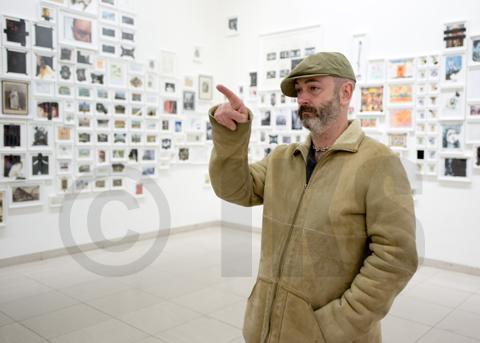
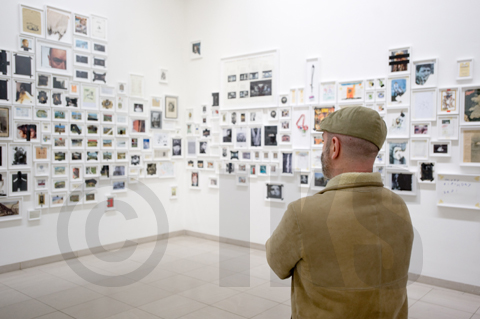
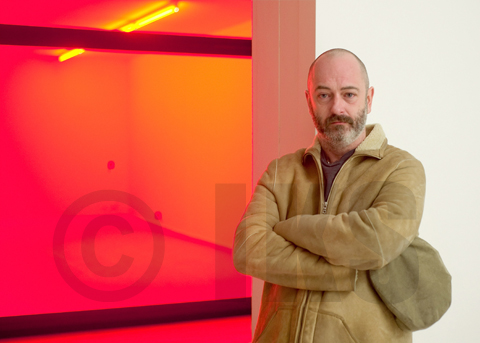
Photo: Dirk Rose © IKS-Medienarchiv