


John Myers
The Concept of the Unspectacular and the Poetics of Everyday Life in the Work of John Myers
The British photographer and painter John Myers (born 1944 in Bradford) is one of the most incisive chroniclers of British post-war modernism, although he has operated far from the mainstream for decades. Myers studied Fine Art under Richard Hamilton at Newcastle University and subsequently taught art history and painting at the Stourbridge College of Art and the University of Wolverhampton from 1969 to 2001. His core photographic phase spanned a relatively short but conceptually highly condensed period between 1972 and 1979 in Stourbridge, a small town in the West Midlands.
In contrast to contemporary representatives of socially critical documentary photography, who focused primarily on political conflicts or dramatic social grievances, Myers devoted himself to an aesthetic of the "unspectacular." His works capture the unexcited reality of the British middle class and suburban culture ("Middle England") in sober, factual black-and-white photographs taken with an analogue 5x4 large-format camera. Two of his most important groups of works from this era are the series „Portrait“ and „TV“.
The Series „The Portraits“
In his portrait series, which was created throughout the 1970s, Myers photographed neighbors, acquaintances, workers, and children in their immediate living and working environments—such as living rooms, backyards, or retail spaces. The photographs deliberately dispense with visual drama or psychological staging. The sitters usually look directly, distantly, and unvarnished into the camera. The specificity of this series lies in its dual function as a psychological document of the era and a design-historical record. The meticulously depicted interiors—dominated by geometrically patterned wallpaper, bulky velour sofas, and glassware knick-knacks—reflect the collective self-image and aesthetics of British suburbia during that period. Critics often compare the formal rigor and unbiased sobriety of his portraits to the work of Diane Arbus.
The Series „The Ten Televisions“ (1973)
The series realized in 1973, often referred to as „The Ten Televisions“, is considered a pioneering example of Myers’ visual principle of "Looking at the Overlooked." For this project, Myers photographed ten conventional television sets in the living rooms of various households. The conception of the series breaks radically with the actual function of the medium: the devices are switched off. Instead of flickering images from a cathode-ray tube, the lifeless, dark screen only displays the matte reflections of the opposite window or the surrounding room. The television thus loses its medial omnipotence and is degraded to a banal, sculptural piece of furniture within the domestic interior in the tradition of a classical still life. The series functions as an early media-critical and conceptual reflection on the omnipresence and simultaneous material banality of technology in private spaces.
Original Prints and Documentation in the IKS Collection
The art-historical relevance and physical presence of Myers' photographic oeuvre are directly preserved within the holdings of the IKS (Institut für Kunstdokumentation und Szenografie). The collection of the IKS includes rare original vintage prints by the artist, which serve as essential physical resource material for academic research. In addition to these tangible artifacts, the IKS holds a comprehensive 30-minute film interview with John Myers, conducted by filmmaker and curator Ralph Goertz during his studio visit to Stourbridge in 2019. This audiovisual document provides invaluable context for contemporary art history by allowing the artist to articulate his conceptual methodology, technical processes, and sociological insights first-hand.
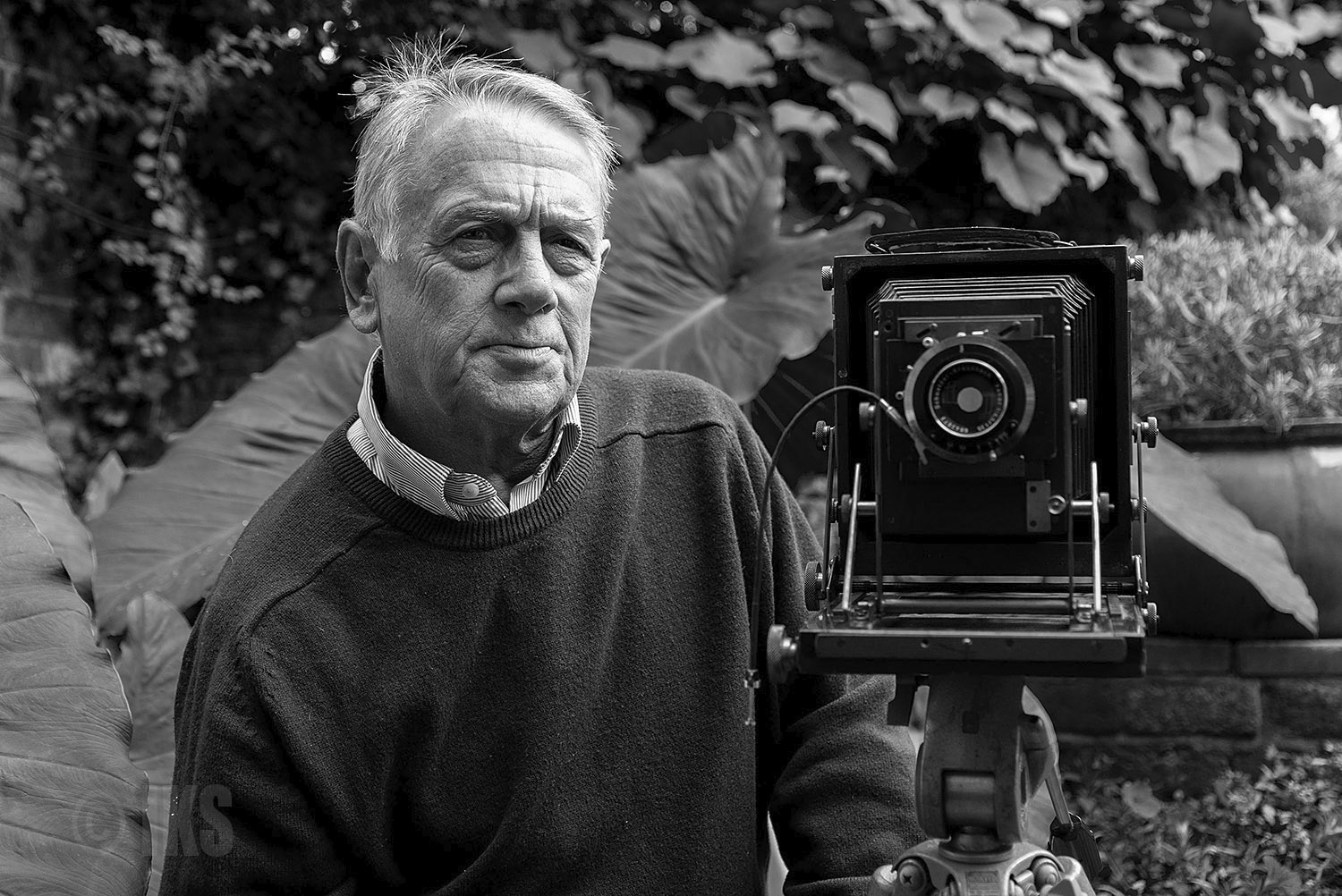
John Myers, Stourbridge, 2019 © IKS-Medienarchiv