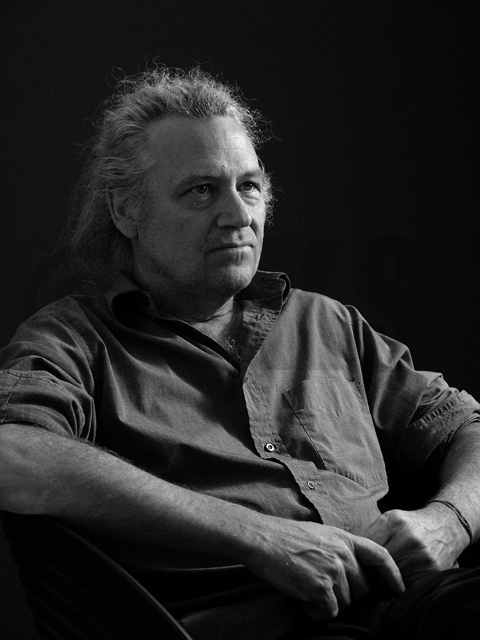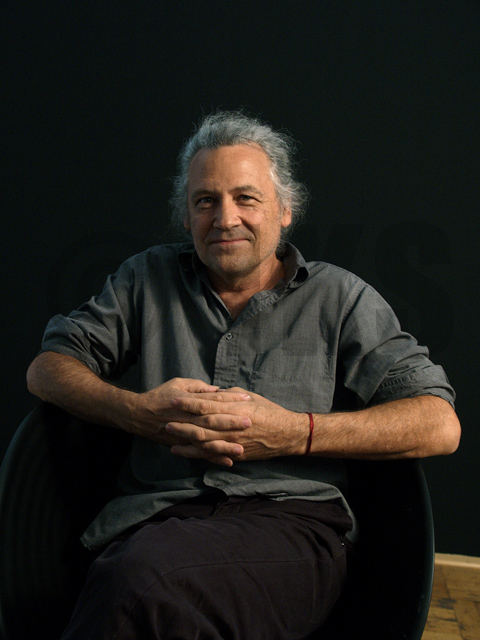

Gary Hill
Epistemology of the Image and Media Deconstruction in the Work of Gary Hill
The American media artist Gary Hill (born on 4 April 1951 in Santa Monica, California) is regarded as one of the leading pioneers of international video art. Since the 1970s, his complex video works and large-scale mixed-media installations have engaged analytically with the processes of human perception, the functioning of language, and the structural influence exerted by technical media. Hill’s theoretically grounded approach breaks with conventional narrative structures of the moving image. His early work, in particular, is characterised by an intensive exploration of the dialectic between text and image (intertextuality) and the viewer’s relationship to their own body (physicality). For Hill, technology functions not merely as a medium of representation, but as an epistemological instrument for revealing the fragmentation of the modern subject and the mechanics of human consciousness.
A key milestone in the European reception of his work was the comprehensive retrospective ‘Gary Hill – strange trajectories’, which took place in autumn 2007 at the NRW-Forum Düsseldorf. This major exhibition was conceived and organised by the imai Foundation – inter media art institute, an institution dedicated to the preservation, research and dissemination of media art. Spanning some 1,200 square metres, the exhibition presented significant large-scale installations and an extensive video programme, including the prominent new productions “Frustrum” and “Guilt”, as well as restored historical works such as “In Situ” (1986/2007). The Düsseldorf presentation thus provided a scholarly platform for systematically re-evaluating the multifaceted relationship between space, sculpture and electronic signals in the artist’s oeuvre.
The complex structure of this space- and media-intensive exhibition in 2007 was exclusively documented on film by the director and curator Ralph Goertz. The resulting documentary film produced by the IKS Media Archive makes a substantial contribution to art-historical source research. The film deconstructs the technical and conceptual transformation of the installation works within the exhibition space and also features one of the rare, in-depth interviews in which Gary Hill speaks explicitly about his image-analytical strategies, his philosophical points of reference and his artistic methodology.
From a media-technical perspective, the documentary itself reflects the historical development of digital archiving: The visual material was recorded in 2007, the year of its creation, in the analogue or early digital television standard of the time (4:3 aspect ratio) on professional Betacam SP magnetic tapes as well as in DV format. In order to permanently preserve this historical document for research and the public, the source material underwent an extensive digital restoration. Thanks to this conversion and restoration, the film document is now available in the contemporary, high-resolution HD format (16:9). This not only ensures the preservation of the visual details of Hill’s highly complex installations, but also documents the necessary technological shift within the field of video-based art studies.